Surface Area & Volume

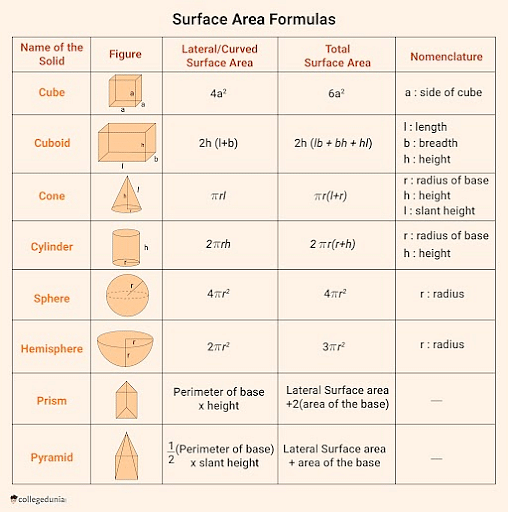
Surface Area and Volume of Solids: Surface area is explained as the sum of the areas of all the closed surfaces of a solid. There are three types of surface area: lateral surface area, curved surface area, and total surface area. Volume is a mathematical quantity that defines the capacity of a solid object.
We may see a variety of solid shapes all around us. We may calculate the surface area and volume of various solid shapes using specific formulas. A cube, cuboids, cylinders, cones, and other solid bodies can be used. We will go over how to calculate the surface area and volume for each of these shapes. Continue reading to learn more about Surface Area and Volume formulas, definitions, formulas, examples, etc.
What is Surface Area?
The surface area of an object is the total area that the object occupies including its base. It is also defined as the total area of all the faces of the object. Its unit is usually the square of any length unit. The surface area of any three-dimensional object can be calculated.
There are two types of surface area:
- Curved/ Lateral Surface Area
- Total Surface Area
What is Volume?
Volume is the measure of space inside a given solid figure. Its unit is always “cubic” which is the elements of little elements of the cube that could fit inside it. Volume is the space that the three-dimensional figure occupies. An object can be either solid or hollow.
Perimeter Definition
The perimeter of a figure is considered the length of the boundary of any figure. Its unit is similar in length like m, cm, km, etc.
Surface Area of Cube and Cuboid
Following is the table for the formula of the given surface area and volume of different figures:
| Type | Formula |
|---|---|
| Surface Area of a cuboid with Length, Breadth and Height | 2(LB+BH+LH) |
| Lateral surface area of Cuboids | 2(L+B) H |
| Diagonal of a cuboid | √(L² + B² + H²) |
| Volume of the cuboid | LBH |
| Length of 12 edges of the cuboid | 4(L+B+H) |
| Surface area of cube of side L | 6L2 |
| Lateral surface area of Cube | 4L2 |
| Diagonal of a cube | √3 a (a = length of the edge) |
| Volume of a Cube | a3 (a= length of the edge) |
Surface Area of Right Circular Cylinder
The radius of a Cylinder- The radius of the circular base of a cylinder is called the radius of a cylinder. The radius is usually denoted by “r”.
- Height- The length of a cylinder's axis is the height of the cylinder. The height is denoted by “h”.
- Lateral Surface- The lateral surface is the curved surface joining the two bases of the right circular Cylinder.
| Type | Formula |
|---|---|
| Curved or the lateral surface area | 2πrh |
| Total surface area of the cylinder | 2πrh+2πr2 or 2πr (r+h) |
| Volume of the cylinder | πr2h |

Surface Area of Right Circular Cone
The radius of a cone- The radius of the circular base of the cone is its Radius(r).
Height of the cone- The length of the line segment that joins the cone's vertex to the center in its base is called the height (h) of the cone.
Slant Height of the Cone- The length of the line segment that joins the vertex to any point on the circular edge of the cone is known as the cone's slant height. It is denoted by “L”.
Lateral Surface Area- The curved surface that joins the base and the uppermost part of a right circular cone is known as its Lateral Surface Area.
| Type | Formula |
|---|---|
| Curved/ Lateral Surface Area of Cone | πrL |
| Total Surface area of Cone | πr (L+r) |
| Volume of Cone | πr2 (h/3) |
Surface Area of Sphere and Hemisphere
A sphere is a spherical, three-dimensional object. Three axes—the x, y, and z axes—are used to define the sphere. While, a plane through the center of a circle sphere divides it into two parts. Each part of the sphere is known as its Hemisphere.
- Radius- As usual the radius of the circle that is formed.
- Lateral Area for Sphere- Total surface area of the sphere.
- Lateral Surface Area of the hemisphere- It is the curved surface area leaving the circular base.
| Type | Formula |
|---|---|
| Surface Area of Sphere | 4πr2 |
| Volume of the sphere | πr3 |
| Curved Surface area of Hemisphere | 2πr2 |
| Total surface area of a Hemisphere | 3πr3 |
| Volume of a Hemisphere | πr3 |
| Volume of a spherical shell (Where outer Radius is “R” and inner Radius is “r”) | π(R3 - r3) |
Surface Area of Frustum of Cone
H- This is denoted as the vertical height of the frustum.
I- The slant height of the Frustum is denoted by l.
The radii of the two bases of a frustum are denoted by r1 and r2.
| Type | Formula |
|---|---|
| Volume of Frustum of cone | 12πh (r12+r22+r1r2) |
| Slant Height of the Frustum | (h2+(r1+r2)2)1/2 |
| The curved surface area of the frustum | πl(r1-r2) |
| Total Surface area of the frustum | πlr1+r2+ π(r12+r22) |
Surface Area of Prism
A prism is defined as an object which is three dimensional and made up of two polygon shaped bases and rectangular shaped lateral faces. The prism has two types of surface area: lateral and total surface area.
The Lateral Surface Area of a Prism: base x perimeter x height
Total surface area of a prism: is lateral surface area + area of two bases
There are 7 types of a prism based on their shape. Hence the surface area of the different types of a prism are-
The formula for the volume of a prism is: V = Bh
Where B is the area of the base.
And the perimeter of a prism: Sum of all the Lengths of the Sides
Surface Area and Volume Formula List
Shape Lateral / Curved Surface Area (Square Units) Total Surface Area (Square units) Volume (Cubic units) Cube LSA = 4l2 TSA = 6l2 V = l3 Cone CSA = πrl TSA = πr(l + r) V = (1/3)πr2h Cuboid LSA = 2h(l + b) TSA = 2(lb + bh + lh) V = l × b × h Cylinder CSA = 2π × r × h TSA = 2πr(h + r) V = πr2h Frustum CSA = π(r1+r2)l TSA = π(r1 + r2)l + π(r12 + r22) V = (1/3)πh(r12 + r22 + r1r2) Hemisphere CSA = 2πr2 TSA = 3πr2 V = (2/3)πr3 Sphere CSA = TSA = 4πr2 TSA = CSA = 4πr2 V = (4/3)πr3
Shape | Lateral / Curved Surface Area (Square Units) | Total Surface Area (Square units) | Volume (Cubic units) |
Cube | LSA = 4l2 | TSA = 6l2 | V = l3 |
Cone | CSA = πrl | TSA = πr(l + r) | V = (1/3)πr2h |
Cuboid | LSA = 2h(l + b) | TSA = 2(lb + bh + lh) | V = l × b × h |
Cylinder | CSA = 2π × r × h | TSA = 2πr(h + r) | V = πr2h |
Frustum | CSA = π(r1+r2)l | TSA = π(r1 + r2)l + π(r12 + r22) | V = (1/3)πh(r12 + r22 + r1r2) |
Hemisphere | CSA = 2πr2 | TSA = 3πr2 | V = (2/3)πr3 |
Sphere | CSA = TSA = 4πr2 | TSA = CSA = 4πr2 | V = (4/3)πr3 |
Surface Area and Volume Solved Examples
Que 1: Find the lateral surface area of a cylinder with a base radius of 10 cm and height 20 cm.
Solution:
Given radius r = 10, height h = 20
LSA = 2πrh
= 2 * π* 10 * 20
= 400π
= 400 x 3.14
= 1256.7
The LSA of given cylinder is 1256.7 cm2 or 12.5 m2
Que 2: Find the total surface area and volume of a cuboid with length 5 cm, breadth 4 cm and height 3 cm.
Solution:
Given length 5 cm, breadth 4 cm and height 3 cm
TSA = 2(lb + bh + lh)
= 2(5*4 + 4*3 + 5*3)
= 2(20 + 12 + 15)
= 2 * 47
= 94 cm2
Volume = l × b × h
= 5 * 4 * 3
= 60 cm3
Conclusion:
From the above mentioned formulas and concepts it is clear that surface area is the area covered by a three-dimensional object. Total surface area refers to the area covered by the entirety of an object whereas curved surface area means only the area of the curved part of an object.
Volume of an object is the ability for the object to hold something in it. The units are cubic units. Volume, too, is only identified for a three-dimensional object.
References
- ^ Weisstein, Eric W. "Surface Area". MathWorld.
- ^ "Schwarz's Paradox" (PDF). Archived (PDF) from the original on 4 March 2016. Retrieved 21 March 2017.
- ^ "Archived copy" (PDF). Archived from the original (PDF) on 15 December 2011. Retrieved 24 July 2012.
- ^ Rorres, Chris. "Tomb of Archimedes: Sources". Courant Institute of Mathematical Sciences. Archived from the original on 9 December 2006. Retrieved 2 January 2007.
- ^ Nasr, Somaye; Plucknett, Kevin P. (20 February 2014). "Kinetics of Iron Ore Reduction by Methane for Chemical Looping Combustion". Energy & Fuels. 28 (2): 1387–1395. doi:10.1021/ef402142q. ISSN 0887-0624.
- ^ Paumard, Patrick; Vaillier, Jacques; Coulary, Bénédicte; Schaeffer, Jacques; Soubannier, Vincent; Mueller, David M.; Brèthes, Daniel; di Rago, Jean-Paul; Velours, Jean (1 February 2002). "The ATP synthase is involved in generating mitochondrial cristae morphology". The EMBO Journal. 21 (3): 221–230. doi:10.1093/emboj/21.3.221. PMC 125827. PMID 11823415
Comments
Post a Comment